
The Presidential election in 2016 saw Donald Trump win in what was considered a shocking outcome by the national media and political pundits. The final vote tally came in direct contrast to what a majority of the polling data showed before the election.
Hillary Clinton held a significant lead over Donald Trump in the polls right up until Election Day. Polling organizations were highly criticized for failing to provide accurate estimates that the voting public could rely upon. After it was clear that the industry as a whole had underestimated the support for the Republican candidate.
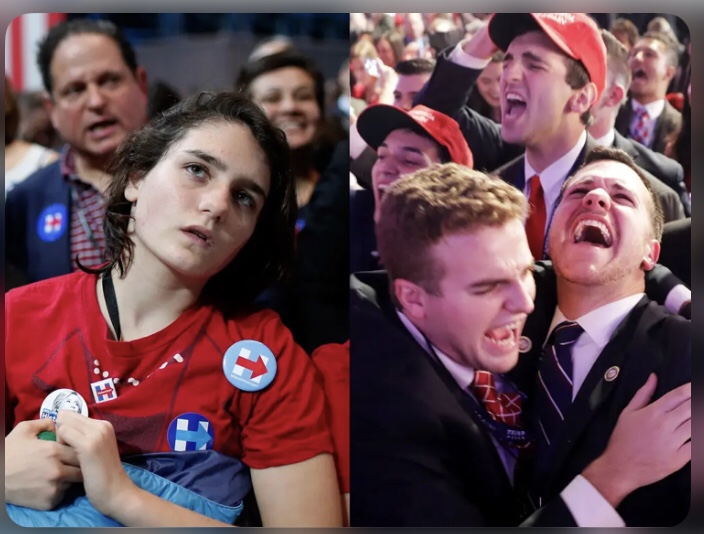
The 2016 Presidential results sent shockwaves through polling agencies throughout the nation. The question remained whether the election was a one-time mistake or if the industry needed to completely overhaul its system of opinion collection. When the 2020 Presidential polling data was again skewed in favor of the Democrat Joe Biden and Trump outperformed pre-election polls. Political analysts everywhere knew that 2016 was not a fluke and that major changes to their data collection systems would have to take place.
According to a study published by the Pew Research Center “In the wake of the 2016 presidential election, it was unclear if the polling errors were an anomaly or the start of a longer-lasting problem. 2020 provided an answer, as most polls understated GOP support a second time.”
As stated on its website “Pew Research Center is a nonpartisan fact tank that informs the public about the issues, attitudes, and trends shaping the world. We conduct public opinion polling, demographic research, content analysis, and other data-driven social science research. We do not take policy positions.”
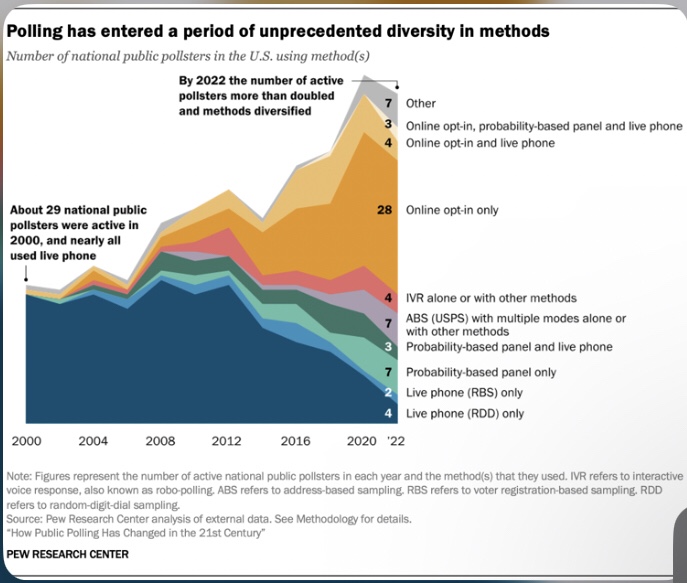
Prior to the 2022 election cycle a recent Pew study of the polling institutes, found that a majority of companies changed their data collection techniques. To get a better representation of the previously underreported Republican supporters.
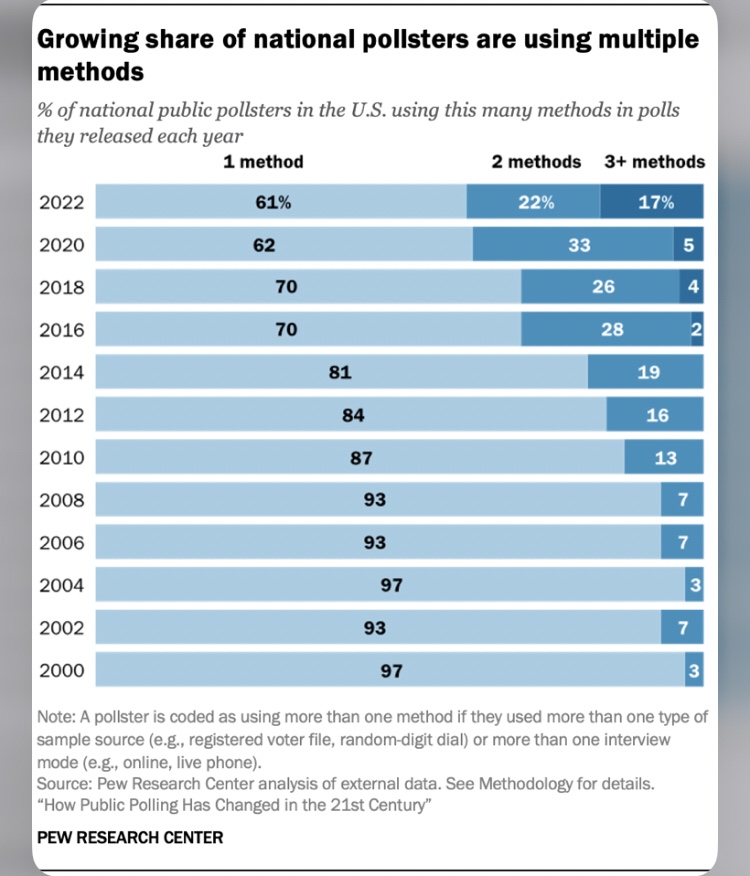
“The 2016 and 2020 presidential elections left many Americans wondering whether polling was broken and what, if anything, pollsters might do about it. A new Pew Research Center study finds that most national pollsters have changed their approach since 2016, and in some cases dramatically. Most (61%) of the pollsters who conducted and publicly released national surveys in both 2016 and 2022 used methods in 2022 that differed from what they used in 2016.”

Although a majority of the companies have chosen to change their collection techniques from 2016 to 2022. The methods used vary throughout the industry. “Live caller” polling once the standard of polling research has changed to a more modern approach. Utilizing email and SMS texting has now become the norm in the opinion collection community. Some companies choose to use a multi-layered approach using up to three different methods. As the study confirmed.
“The changes observed from 2020 to 2022 were more of a mix. During that period, some added an approach like text messaging (e.g., Change Research, Data for Progress), probability-based panels (Politico, USA Today) or multiple new methods (CNN, Wall Street Journal).”
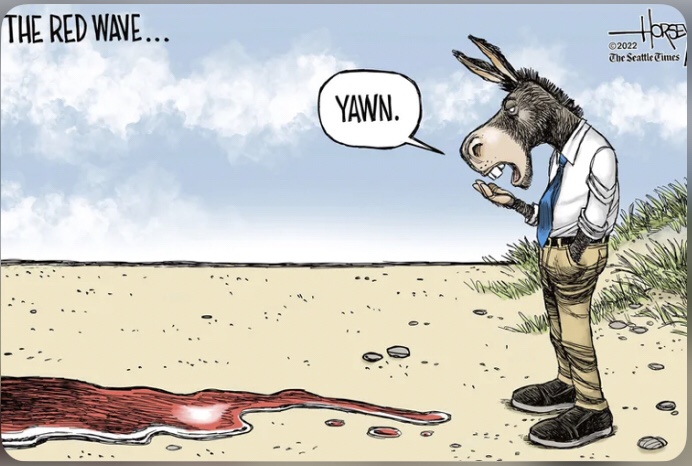
The 2022 midterm election was the first time that the polling industry could see how their overhaul of collecting opinions for their polls would hold up to the actual election results. It appears as though the pendulum may have swung towards underreporting the Democrats. The Republican “Red Wave” that was predicted by analysts who studied the polling data never materialized. In fact, Democrats outperformed Republicans across the country. Leading some to question if modern opinion polling is not an accurate measure of future election outcomes.
Tom Bonier of TargetSmart a company that focuses on voting data rather than opinion polling to predict election outcomes. In an interview with The Intercept said “I can see now these analysts who are focused exclusively on polls and aren’t using the other data, the voter registration data, the special election data, the fundraising data, the early vote data, if you’re just calibrating on polls, sure the polls were better, but now we have a Republican-biased election where almost all the polls, every poll, basically outside of Florida, was biased towards Republicans. So that’s going to have to factor in the equation now.”
Bonier was ridiculed leading up to the 2022 midterms for predicting that Democrats would perform much better than the opinion polls, based on the actual voting records he studied. When the results were tallied Bonier’s data-based predictions were extremely consistent with the actual outcome. To Bonier, the course correction the opinion polls made is now flawed towards Republicans.
“To the extent that there’s a response bias, it’s that they’re getting a more conservative youth sample because young Republicans are more survey responsive than Young Democrats.”
Bonier added, “ I talk about this again and again and again, but I don’t think it can be repeated enough — women under the age of 25, in Kansas, when you look at what percent of registered voters, women under the age of 25 voted in that early August primary election, a higher percent of them voted than the percent of all men registered voters who voted in that election.”
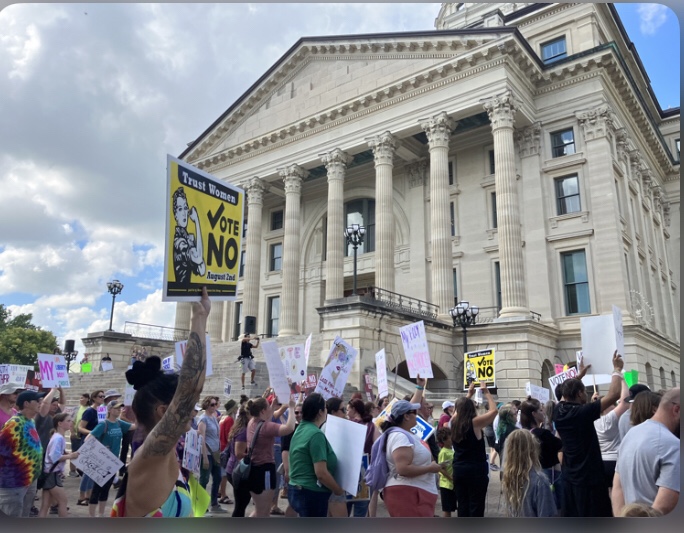
Using a collection of voting data from special elections like the one in Kansas on reproductive rights. Is an accurate representation of how the voting public will turn out to vote during elections in that same time frame. For a historically Republican electorate to overwhelmingly support a democratic cause should have been an indication that the Democratic base was motivated. Yet media outlets and their talking heads discount hard data because opinion polls fit their narrative. Even though the current technology used to measure public opinions favors Republicans.
A study published by “Data for Progress” a left-leaning think tank found “In 2022, SMS shows a relatively consistent 5-point margin bias toward Republicans. This is the opposite of the bias we observed in 2020 toward Democrats as a result of higher rates of within-partisan-dynamic nonresponse biases.”
It appears the method that most polls use in their formulas is SMS texting. The report concludes “However, a trend we have observed is that SMS recruits too many motivated or engaged hard partisans, and not enough persuadable voters. Our analysis finds this feature of SMS makes it a more reliable mode in polling primaries,”
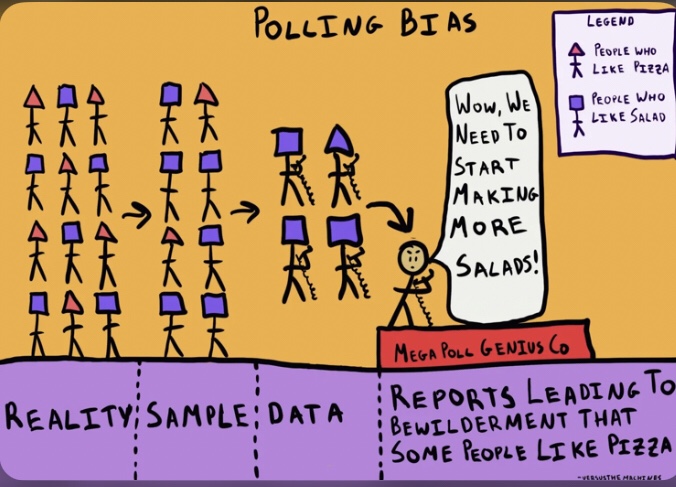
SMS captures a better understanding of how primary results will fare in comparison to general elections because Democratic voters have wavering opinions about their candidates. Meaning it doesn’t accurately predict what they will do come Election Day. So it doesn’t make any difference when they are lumped in with other Democratic voters during primaries. When they are thrown into a race with Republican voters the results tend to favor Republicans because the Democrats are more pliable with their opinions.
“In fact, our SMS captured more persuasion from Biden voters than from Trump voters (Biden voters switching to Republican candidates this cycle). This implies that Democrats were switching from their party when voting at higher rates than Republicans, which is likely not what occurred in the election.”
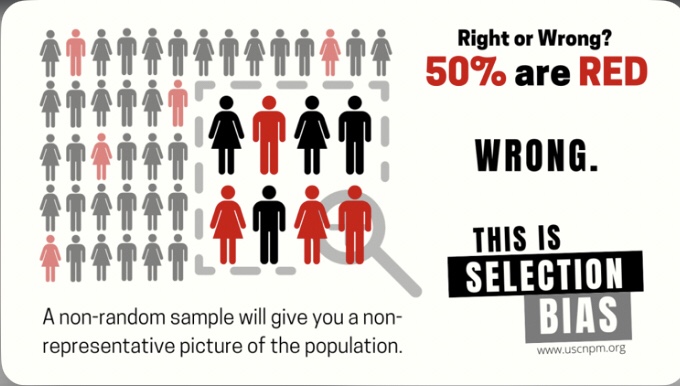
Democrats who participated in SMS collection tend to be more critical of their party than Republicans are. However, when it comes down to voting they tend to still vote Democratic. Most of the modern opinion methods used show a greater percentage of bias compared to the traditional method of “live calling”.
“When separating each mode to be weighted independently, our live-caller polling showed the lowest polling margin bias, an average of 0.5 points toward Democrats. SMS and web panels are more consistent but exhibit opposing biases (SMS favors the Republican, web the Democrat). Both interactive voice response (IVR) and mail both show biases that favor the minority party in a given state.”
With so much backlash against the polling industry after they failed in the 2016 and 2020 Presidential Elections. It was a necessary step to make wholesale changes to their collection techniques. However, it appears from the data that the system corrections made now created a bias toward Republicans. After the 2022 polling results were compared to election data. In today’s climate, Democratic voters tend to hold their elected officials to higher standards. While the Republican base has become more extreme and their support of GOP candidates doesn’t waver. Opinion-based polls will continue to overestimate Republican support. When actual voting data is the only true indicator of how a general election will turn out.
The media treats opinion polls generated by hundreds of people who are knowingly participating as fact. While they overlook the actual data of millions of registered voters. Putting more weight on the public’s perception than on their actions. Is extremely short-sighted if you are truly trying to predict the outcome of an election. It makes you question whether the media and the political pundits are interested in what will happen in upcoming elections or whether are they more concerned with having a poll that fits their political narrative. So the next time the latest poll is plastered across all media platforms. You may contemplate who agreed to participate with their opinions and what their motivations are. Yet the organizations that gathered those viewpoints are well aware that their methods will result in conclusions that will create the most buzz and pageviews that they can monetize. This begs the question are political polls an accurate account of future elections or are they a tool for corporations to strengthen their profits for their shareholders? Either way, it appears that Republicans are now the Party benefitting from the skewed collection of public perception.
For the articles quoted in this piece click the links below
https://www.pewresearch.org/methods/2023/04/19/how-public-polling-has-changed-in-the-21st-century/
https://theintercept.com/2022/11/23/deconstructed-midterm-elections-democrats
https://www.dataforprogress.org/blog/2022/12/2/dfp-2022-polling-accuracy-report/

 The-Anti-Social-Media Pro-DEMOCRACY WING
To CEO;
This is a great review of polling methods and it’s history and it took me about three days to read it all.
A little long but we’ll investigated!
Thanks
LikeLike